
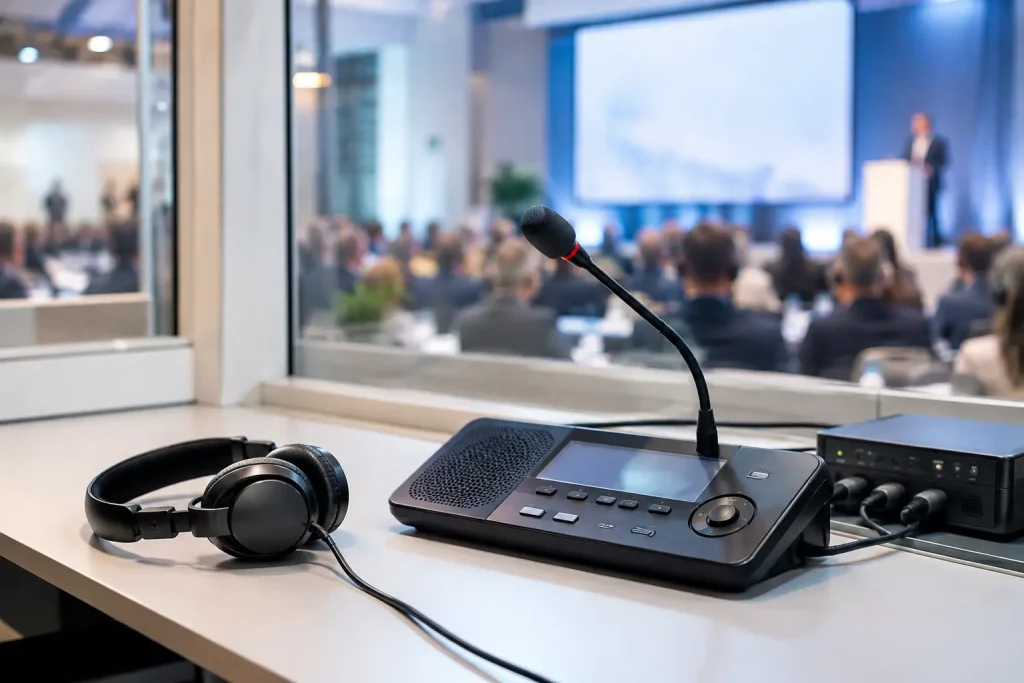
A multilingual conference can appear perfectly organised until a delegate puts on a headset and hears silence, the wrong language, or an interpreter struggling against poor audio. This conference translation equipment guide is designed to prevent that moment. The right system is not simply a technical add-on. It affects comprehension, participation, accessibility, room design, budgets and the credibility of the whole meeting.
My practical approach is simple: begin with the communication outcome, then specify the equipment. Too many planners do this in reverse. They accept a line in an AV quotation for “translation system”, only to discover later that it excludes interpreter booths, technician time, receiver distribution, internet provision or the return of 300 headsets after the final session.
Start with the interpretation format
Before selecting equipment, establish how language will be delivered. “Translation” is widely used in event planning, but conference interpretation is normally spoken in real time. The format determines the system, the staffing and the risk profile.
Simultaneous interpretation is the usual choice for congresses, conferences and high-level meetings. Interpreters work from sound-isolated booths, hear the floor language through headsets and speak into microphones. Delegates select their required language on a receiver or their own device. It keeps the agenda moving, but it requires disciplined technical planning.
Consecutive interpretation is different. A speaker pauses every few sentences while the interpreter delivers the message. It needs less specialist equipment, although the session takes roughly twice as long. It can work for small meetings, press briefings, protocol occasions or site visits. It is rarely the right answer for a packed plenary programme.
Whispered interpretation is for one or two people, usually with a portable receiver system. It may be useful for a VIP delegation or a guided tour, but it is not a discreet shortcut for a room of 20 delegates. Once numbers grow, speech spill, poor audibility and uneven delegate experience become obvious.
Ask one decisive question at the outset: which languages must delegates hear, and which languages might speakers use? These are not always the same. A conference may have English as the floor language, with interpretation into French, German and Spanish. Or it may need two-way interpretation because speakers will present in several languages. That distinction affects interpreter numbers, channels and the complexity of the audio routing.
Conference translation equipment guide: what the system includes
A professional simultaneous interpretation system has several connected parts. If one is missing or poorly specified, the system is incomplete.
The interpreter booth provides acoustic separation and a controlled working environment. For formal conferences, it should meet the relevant ISO requirements for sound insulation, ventilation, sightlines and interpreter working space. Do not accept a makeshift backstage position with a partial view of the stage as equivalent. Interpreters need to see speakers, presentation content and the room proceedings. A booth hidden behind drape may save money on paper and cost clarity in practice.
Inside the booth, an interpreter console lets each interpreter hear the floor audio, select relay languages where required and send their interpretation to the correct outgoing channel. The console is connected to the event audio system, not treated as a separate island. The interpreter needs clean audio from every live microphone, playback source and remote contributor.
Delegates receive language channels through infrared, radio frequency, DECT or app-based technology. Each has a place:
- Infrared systems are contained within the room and can suit confidential meetings, but require careful radiator placement and can be affected by physical obstructions or strong daylight in some conditions.
- Radio frequency systems offer wider coverage and flexibility, but require frequency coordination, particularly in busy city-centre venues with other events nearby.
- DECT systems can work well for smaller meetings and portable requirements, though channel capacity and local interference must be checked.
- App-based interpretation uses delegates’ own phones and headphones. It reduces receiver handling but depends on reliable Wi-Fi or dedicated connectivity, compatible devices and clear user support.
There is no universally best choice. For a medical congress with sensitive content and hundreds of delegates, a dedicated receiver system may be the safer operational decision. For a smaller corporate meeting with geographically dispersed participants, a properly tested app solution can be practical. The key word is properly. Venue guest Wi-Fi is not automatically suitable for live interpretation traffic.
Specify the delegate experience, not just the kit
A quotation may state “300 receivers and headphones”. That tells you very little about the experience. Confirm the number of languages available, channels programmed, battery type, charging provision, receiver distribution method and spare quantity. A sensible allowance for spares covers lost units, flat batteries and last-minute language changes.
Also consider how delegates collect and return equipment. A large conference can create a queue before the first session if every attendee must sign for a headset at one desk. Pre-positioned receivers at entrances, staffed distribution points or badge-linked collection may be better, depending on security and scale. Build the return process into the room-exit plan. Otherwise, equipment disappears into tote bags, coffee areas and coaches.
Headphones matter more than they appear to. Lightweight single-ear units may suit short sessions, while more comfortable headsets are preferable for a full-day congress. Hygiene procedures should be confirmed, especially for equipment reused across multiple days. For accessibility, ask whether induction loops, hearing-assistance receivers or compatible neck loops are needed. Language access and hearing access should be planned together, not treated as separate late-stage requests.
The audio feed is where many systems fail
Interpreters cannot interpret what they cannot hear. Every source that delegates hear in the room must be available to the booth: lectern microphones, handhelds, panel microphones, video playback, walk-on music where relevant, remote speakers and audience questions.
The common failure is a remote contributor. Their audio may be audible in the room but not routed cleanly to the interpreters, or the interpreter return may not be included in the webcast. Hybrid meetings need a confirmed audio map showing every input and output. Do not settle for “we will sort that on the day”.
Presentation content is equally important. Interpreters should receive slides in advance, including abbreviations, specialist terminology and speaker names. In pharmaceutical, scientific, financial or policy events, a glossary can materially improve accuracy. Equipment carries the signal; preparation carries the meaning.
Plan for relay interpretation
If a speaker presents in Italian and delegates need French, German and English, you may need relay interpretation. One interpreter renders Italian into English, and other booths use the English channel as their source. This is normal in multilingual meetings, but it adds a dependency. If the relay feed is unclear or assigned to the wrong channel, several languages fail at once.
Tell your language supplier the floor languages, target languages and likely speaker languages before they allocate teams. Ask them to confirm the relay plan in writing. It should align with the technical channel plan supplied by the AV team.
Read the quotation for omissions
Translation equipment costs can look reasonable until the operational lines emerge. My preference is to request a clearly itemised quotation rather than a single bundled figure. It gives you something concrete to compare and protects you from assumptions between the venue, AV supplier and language agency.
Check whether the price includes the following:
- Interpreter booths, consoles and installation
- Receivers, headphones, chargers and spare units
- A technician for setup, rehearsals, live operation and strike
- Delivery, collection, porterage and venue access restrictions
- Frequency licensing or coordination where applicable
- Internet, dedicated network equipment and support for app-based systems
- Audio splits, cabling and integration with recording, streaming or hybrid platforms
- Equipment loss, damage and cleaning terms
Venue policies deserve particular attention. Some venues mandate an in-house AV provider, charge external supplier access fees or limit rigging and cable routes. None of these conditions is automatically unreasonable, but they must be known before you finalise a budget. A low equipment hire rate can be overtaken quickly by labour minimums, late access charges and compulsory venue technical supervision.
Test before delegates arrive
A functional test is not the same as a proper rehearsal. The system should be checked with the actual microphones, actual presentation playback, actual remote platform and at least one receiver in the furthest seats. Test every language channel, including relay feeds. Confirm that channel labels match the programme and signage.
Where speakers are joining remotely, test their connection, headset or microphone and backup contact route. Laptop microphones and untreated home offices create difficult conditions for interpreters. Encourage remote speakers to use a wired headset, a stable connection and a quiet room. If they cannot, plan for the limitations rather than pretending technology will remove them.
Brief the chair as well. Fast cross-talk, people speaking away from microphones and audience questions shouted from the back of the room make interpretation harder. A confident chair who asks speakers to use microphones and speak one at a time protects every language channel.
The useful measure is not whether the equipment powers on. It is whether a delegate in the last row can follow a complex idea in their chosen language without effort. Plan to that standard, and your multilingual conference will feel controlled long before the first headset is collected.