
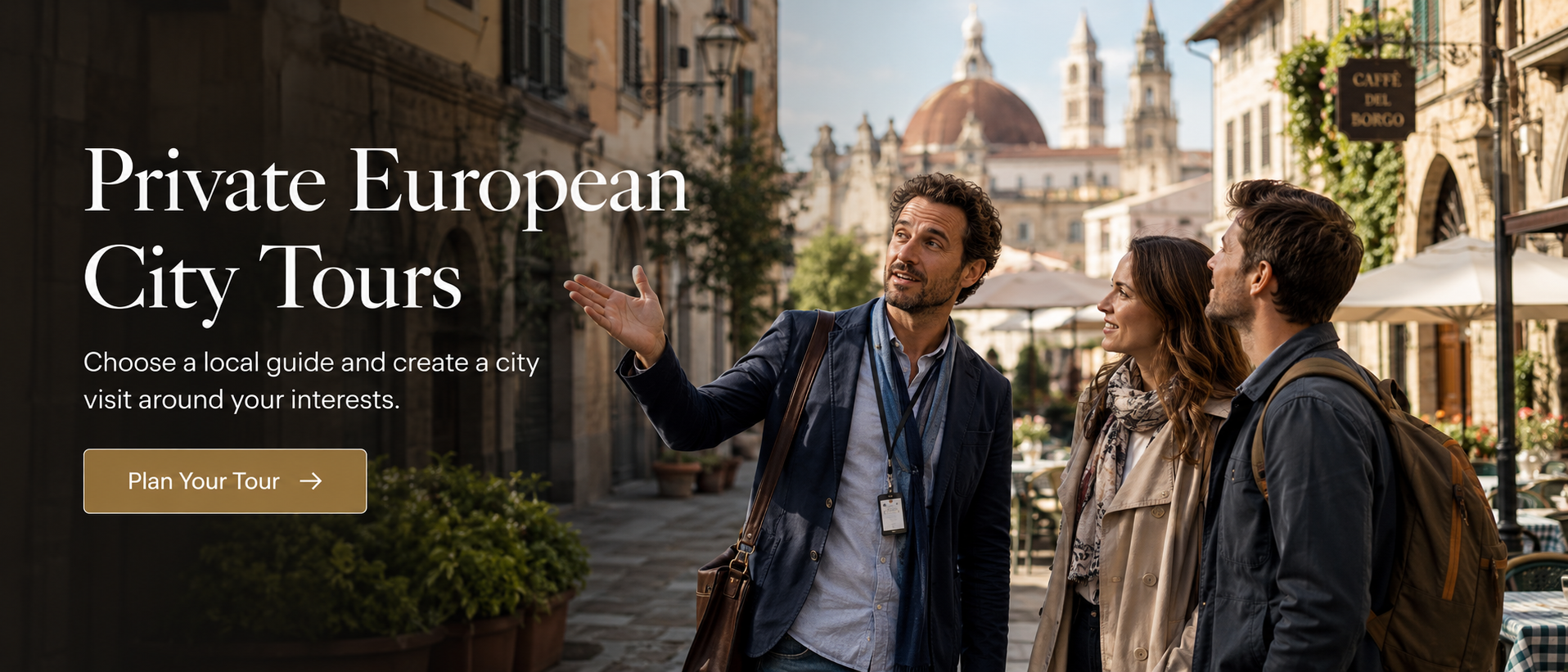
Private European City Tours with Local Guides
How to choose a personal guide and create a city visit around your interests
A private city tour can completely change the way you experience a European destination.
Instead of following a guide holding an umbrella through crowded streets, you can explore at your own pace, ask questions and concentrate on the places that genuinely interest you.
The best private tours are not simply smaller versions of group excursions. They are personal experiences built around the traveller.
You might want to understand the history of Cold War Berlin, discover the food markets of Barcelona, explore Stockholm’s architecture or photograph the canals of Venice before the busiest visitors arrive. A good local guide can shape the day around those interests rather than expecting you to follow a fixed itinerary.
After more than 35 years of travelling and working across European cities, I have learnt that local knowledge can save an enormous amount of time. It can also reveal parts of a city that are easily missed when you rely entirely on guidebooks, maps and online recommendations.
This guide explains how to choose a private local guide, what to ask before booking and how to create a city tour that feels personal rather than predictable.
What is a private city tour?
A private city tour is arranged exclusively for you and the people travelling with you.
Unlike a large organised excursion, you are not normally sharing the guide with strangers. The group may consist of one person, a couple, a family or a small party of friends.
Tours can be:
- Walking tours through a historic centre
- Food and market tours
- Art, architecture or museum tours
- Photography tours
- Evening or nightlife tours
- Private driving tours
- Shore excursions from cruise ports
- Tours designed around mobility requirements
- Specialist historical or cultural experiences
Some guides offer established itineraries that can be adjusted. Others will create an entirely bespoke tour after discussing your interests.
The important difference is flexibility.
A private guide can usually change the route, slow the pace, spend longer at a particular location or remove places that do not interest you.
Affiliate disclosure: Some links on this page are affiliate links. If you make a booking through one of these links, I may receive a small commission at no additional cost to you. This helps support the travel articles and guides on this website.
Why book a private local guide?
You see the city through local eyes
Maps can show you where a building is located. They cannot always explain why it matters, how the surrounding neighbourhood has changed or what local people think about it.
An experienced guide can add the stories and context that turn a collection of streets and monuments into a living city.
They may also introduce you to smaller squares, independent cafés, unusual viewpoints and neighbourhoods that would be difficult to discover during a short visit.
The tour can reflect your interests
Many conventional city tours are designed to appeal to the widest possible audience. They cover the major sights but may not explore any particular subject in depth.
A private guide allows you to be more specific.
You could ask for a tour concentrating on:
- Medieval history
- Modern architecture
- Music and entertainment venues
- European political history
- Local food and drink
- Churches and religious art
- Industrial heritage
- Film locations
- Conference and event venues
- Public transport systems
- Street photography
- Second World War history
The more clearly you describe your interests, the easier it is for the guide to create a worthwhile experience.
You make better use of limited time
A weekend in a European city passes quickly.
It is easy to lose an hour finding an entrance, travelling to the wrong station or discovering that an attraction requires advance tickets.
A knowledgeable guide can help you move through the city more efficiently. They should understand local transport, realistic walking times, opening arrangements and the best order in which to visit different areas.
This does not mean rushing from landmark to landmark. It means spending more of your available time experiencing the city rather than solving avoidable logistical problems.
You can ask questions
The ability to have a conversation is one of the greatest advantages of a private tour.
You are not limited to listening to a rehearsed commentary. You can ask about local customs, transport, neighbourhoods, architecture, restaurants and everyday life.
A good guide will recognise when you want detailed information and when you would prefer a quieter moment to look around.
Decide what you want from the tour
Before searching for a guide, think about what would make the tour successful for you.
“Show me the city” is a reasonable starting point, but it gives the guide very little information.
A better request might be:
We are visiting for the first time and would like to see the principal historic sights, but we are particularly interested in architecture and would prefer quieter streets to shopping areas.
Or:
We have already visited the major attractions. We would like to explore residential neighbourhoods, local markets and places that show how people live in the city today.
Consider the following questions:
- Is this your first visit?
- Which places have you already seen?
- What subjects interest you most?
- How far are you comfortable walking?
- Would you like to use public transport?
- Are you travelling with children?
- Does anyone have limited mobility?
- Would you prefer a detailed historical tour or a relaxed introduction?
- Do you want to enter attractions or remain outdoors?
- Are you interested in food, photography or shopping?
- How much time do you have available?
Send this information to the guide before you book or immediately afterwards.
It gives them an opportunity to suggest a more suitable route and identify anything that may be unrealistic.
How to choose the right local guide
Read the guide’s profile carefully
Do not choose a guide solely because they appear first in the search results.
Read their biography and look for evidence that their experience matches your interests.
Someone who specialises in art history may be ideal for the museums of Florence but less suitable for a street-food tour. A guide with experience in architecture, music or political history may offer a completely different view of the same city.
Look for information about:
- Professional experience
- Areas of specialist knowledge
- Languages spoken
- Guiding qualifications where applicable
- The types of travellers they usually work with
- Whether tours are private or shared
- Whether they provide walking, driving or public-transport tours
In some destinations, guides working at particular sites or monuments may need specific accreditation. Requirements vary between cities and countries, so ask the guide whether any specialist licences or local guides are required for your proposed itinerary.
Examine recent reviews
Reviews can be useful, but the overall star rating tells only part of the story.
Read the written comments and look for recurring themes.
Do travellers repeatedly mention that the guide:
- Communicated well before the tour?
- Adapted the itinerary?
- Arrived on time?
- Explained complicated subjects clearly?
- Worked well with children?
- Managed mobility requirements?
- Avoided queues or unnecessary delays?
- Recommended worthwhile local places?
- Kept the tour interesting without overwhelming the group?
Recent detailed reviews are generally more informative than a large number of brief comments saying only that the tour was excellent.
Look for compatibility
A private tour involves spending several hours with one person. Knowledge matters, but personality and communication style matter as well.
Some guides are energetic storytellers. Others are academic and detail-focused. Some provide a highly structured itinerary, while others prefer a more conversational walk.
There is no universally correct style. The question is whether that style suits you.
A guide’s profile, introduction video and responses to your messages can often give you a sense of how they communicate.
Ask a specific question before booking
A thoughtful answer can tell you a great deal about a guide.
Instead of sending a general message asking whether they are available, ask something connected to your interests.
For example:
We are particularly interested in Stockholm’s historic architecture and waterfront development. Could those subjects be included in the tour?
Or:
One member of our party cannot walk continuously for long periods. Could the route include regular seating and short public-transport journeys?
The response should show that the guide has read your message and considered your requirements.
A generic reply that simply directs you back to the standard itinerary may suggest that the tour will not be as personalised as you expect.
Questions to ask before confirming your tour
Before paying, make sure you understand exactly what is included.
Ask about:
- The tour’s total duration
- The meeting point
- Where the tour finishes
- The maximum walking distance
- Public-transport costs
- Entrance tickets
- Food and drink
- Private vehicle charges
- Collection from your hotel
- Collection from a cruise terminal
- Accessibility
- Cancellation arrangements
- Bad-weather alternatives
- Additional charges for extra time
Do not assume that museum admission, transport or refreshments are included in the advertised price.
If a vehicle is involved, establish whether the guide is also the driver or whether a separate professional driver will be provided. Ask what type of vehicle will be used and whether luggage, child seats or mobility equipment can be accommodated.
Choose the right tour length
Longer does not always mean better.
Two to three hours
This can work well for:
- A first orientation
- A historic-centre walk
- A specialist neighbourhood
- An evening introduction
- A food-market visit
A short tour can help you understand the city before exploring independently.
Four hours
A half-day tour usually provides enough time to explore several connected areas without becoming exhausting.
This is often the best balance for a walking tour, particularly if you want time to stop for photographs, coffee or detailed explanations.
Six to eight hours
A full-day tour may be appropriate when:
- The city is geographically spread out
- You want to combine several districts
- A private vehicle is being used
- You are taking a cruise-port excursion
- You want to visit locations outside the city
- Your available sightseeing time is limited to one day
Build breaks into a full-day itinerary. Eight hours of continuous facts and sightseeing can become tiring, however knowledgeable the guide may be.
Avoid trying to include too much
One of the most common mistakes when planning a private tour is creating an unrealistic list of attractions.
A carefully planned visit to three or four places is usually more enjoyable than racing through eight.
European cities can involve:
- Congested roads
- Crowded public transport
- Security queues
- Timed entrances
- Steep streets
- Large museum complexes
- Seasonal opening hours
- Demonstrations and public events
- Unexpected closures
Listen when an experienced guide says that the proposed schedule is too ambitious.
The purpose of a private tour is not to collect as many photographs as possible. It is to understand and enjoy the city.
Consider booking the tour early in your visit
For a first visit, I generally recommend arranging a private tour near the beginning of your stay.
You will gain an understanding of the city’s layout and public transport while there is still time to use the guide’s recommendations.
During the tour, you may discover a museum, neighbourhood or restaurant that you would like to return to independently.
Booking a guide on your final afternoon can still be valuable, but you may leave with a list of interesting places that you no longer have time to visit.
Private guides for cruise passengers
A private guide can be especially useful when visiting a city during a cruise.
However, the timing must be planned carefully.
Confirm:
- Whether the ship docks in the city or at a distant port
- The realistic transfer time from the port
- Where the guide will meet you
- Whether transport is included
- The time you must return to the ship
- What happens if the ship arrives late
- Whether the tour is refundable if the port call is cancelled
Do not plan around the ship’s departure time alone. You will normally need to be back on board earlier.
Make sure the guide understands that returning to the ship on time is more important than fitting in one additional attraction.
Private tours for travellers with limited mobility
Private tours can offer far greater flexibility than large group excursions, but accessibility must be discussed in detail.
Avoid relying on descriptions such as “easy walking” or “suitable for most people”. These expressions are subjective.
Tell the guide:
- The maximum comfortable walking distance
- Whether steps are manageable
- Whether regular seating is required
- Whether a wheelchair or walking aid is used
- Whether accessible toilets are needed
- Whether the traveller can enter an ordinary car
- Whether cobbled streets may cause difficulty
Historic European centres can contain steep hills, uneven paving, bridges and buildings without lifts. An experienced guide should be honest about these limitations and suggest suitable alternatives.
Book through a reputable platform
Booking through an established tour platform can provide a clearer record of your itinerary, payment and communication.
It may also allow you to review:
- The guide’s profile
- Previous customer feedback
- Tour inclusions
- Cancellation terms
- Platform support
- Secure payment arrangements
Avoid sending money through an unusual payment method simply because someone offers a lower price.
UK police guidance warns that bogus online adverts and false travel services may appear legitimate until the traveller arrives. Using a recognised booking service, checking reviews carefully and keeping written confirmation can reduce the risk.
Find a private guide for your European city
You can search for local guides, compare profiles and discuss a personalised itinerary before your visit.
Affiliate disclosure: Some links on this page are affiliate links. If you make a booking through one of these links, I may receive a small commission at no additional cost to you. This helps support the travel articles and guides on this website.
How much does a private city tour cost?
Prices vary considerably between cities and guides.
The cost may depend on:
- The guide’s experience and qualifications
- The number of hours
- The destination
- Whether a private vehicle is required
- The number of people
- Attraction tickets
- Evening or weekend timings
- Travel outside the city
- The level of itinerary planning involved
Do not compare tours by price alone.
A cheaper tour may exclude transport and entrance fees. A more expensive guide may have specialist knowledge that is directly relevant to your interests.
Look at the complete experience rather than the hourly figure.
For a couple or family, a private tour can sometimes provide better value than purchasing several places on a premium group excursion. The greatest value, however, usually comes from using the guide’s time well.
Should you tip a private guide?
Tipping customs vary throughout Europe.
In some countries, rounding up or offering a modest gratuity for excellent service is appreciated. In others, tipping is less expected.
A professional guide should not make you feel uncomfortable or imply that a large payment is required beyond the agreed price.
Check the booking platform’s guidance and consider local customs. When in doubt, a sincere thank-you and a detailed positive review are always valuable.
What to do after booking
Send the guide a concise message containing:
- The names and number of travellers
- Your hotel or arrival point
- Your main interests
- Any places you have already visited
- Mobility or dietary requirements
- The language you would like the tour conducted in
- Any fixed-time attraction bookings
- Your contact number while travelling
A few days before the tour, reconfirm the meeting time and location.
Save the details offline in case mobile reception is poor. It is also sensible to keep the platform’s support information and the guide’s contact details available separately.
Before travelling, check the latest Foreign, Commonwealth & Development Office advice for your destination, including information about local laws, transport disruption and safety.
Make the tour part of your wider city visit
A private tour works best when it supports the rest of your journey rather than trying to replace it.
Use the guide to gain context, ask questions and identify places that deserve more time.
You might spend one morning with a guide and then use the following days to revisit a neighbourhood, museum or market independently.
Ask for recommendations, but explain what you actually like. “Where should we eat?” is less useful than:
We would like a relaxed neighbourhood restaurant serving traditional food. It does not need to be fashionable, but we would like somewhere local people genuinely use.
Specific questions usually produce more useful answers.
A personal tour should feel personal
The main reason to choose a private guide is not simply to avoid a large group.
It is to create an experience around your interests, pace and available time.
Choose someone who understands what you want from the city. Be honest about your mobility, budget and priorities. Ask what is included and avoid trying to fit an entire destination into a few hours.
A knowledgeable local guide cannot show you everything.
What they can do is help you notice more, understand more and make better use of the time you have.
Start planning your private European city tour
Search for experienced local guides and find a tour that can be adapted around your interests.
Affiliate disclosure: Some links on this page are affiliate links. If you make a booking through one of these links, I may receive a small commission at no additional cost to you. This helps support the travel articles and guides on this website.