
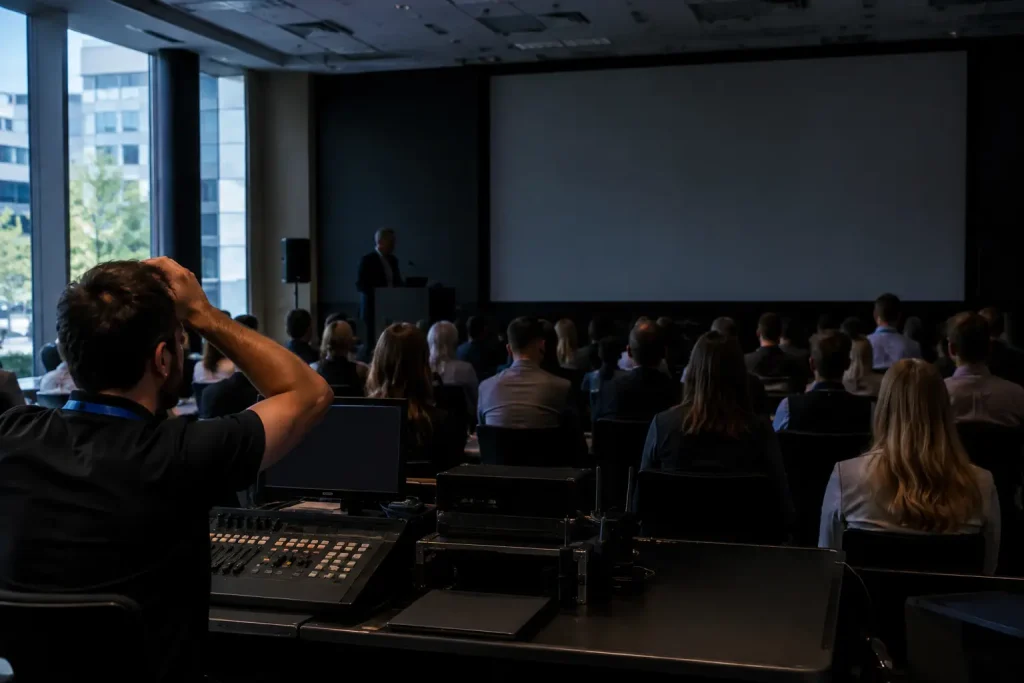
The room goes dark, the screens disappear and, for a few seconds, everyone looks towards the stage. A conference power failure is one of those incidents that can feel much bigger than it is, particularly when delegates, speakers and senior stakeholders are waiting for somebody to take control. The first requirement is not a clever technical fix. It is calm, visible coordination.
A power loss may be a brief interruption on the local grid, a tripped circuit affecting one part of the venue, a failure of a temporary distribution board, or a wider problem that affects the building. Those are very different incidents. Treating them all as “the power is out” wastes valuable time and encourages poor decisions.
The first minutes of a conference power failure
Your immediate priorities are people, information and authority. People need to be safe, particularly in a darkened room with cable runs, temporary structures and unfamiliar exits. Information needs to come from the venue’s responsible engineer, rather than from a well-meaning member of staff who has heard something in a corridor. Authority means agreeing who is running the response, so the organiser, venue duty manager and production manager are not giving competing instructions.
Do not allow the conference team to start moving delegates simply because the room feels uncomfortable. Evacuation is a life-safety decision governed by the venue’s procedures and, where relevant, the fire alarm system. A loss of event power is not automatically an evacuation. Equally, nobody should reassure delegates that they can remain in the room until the venue has confirmed that emergency lighting, exits and other safety systems are functioning as required.
In practice, I would want a fast factual answer to three questions: what has failed, what remains live, and who is investigating it? The distinction matters. If house lighting and emergency lighting remain available but stage power has gone, you may have a production issue. If the venue has lost mains power, the situation belongs primarily with the building and its emergency arrangements.
Avoid the temptation to keep resetting
A tripped breaker is not an invitation for repeated resets. Protective devices trip for a reason: overload, fault current, damaged cable, water ingress, or a problem with connected equipment. Re-energising a circuit without a competent person identifying the cause can turn an inconvenient interruption into damaged equipment or a safety incident.
This is particularly relevant where conference production has expanded late in the day. Extra lighting, a speaker comfort monitor, charging stations, catering equipment or an unplanned broadcast position can alter a carefully calculated load. The most expensive power problems are often created by something that seemed too small to mention.
Why recovery depends on preparation before doors open
A conference does not become resilient because somebody has written “power failure” in a risk register. It becomes more resilient when the venue, organiser and technical suppliers have agreed the practical boundaries before the audience arrives.
The venue should be able to explain its electrical resilience in plain English. Ask what is covered by generator power, how quickly any changeover occurs, whether conference spaces are supported, and what is deliberately excluded. Emergency generation often protects life-safety systems and selected building services, not your LED wall, interpretation system or coffee machines. Assumptions here are common and costly.
The production team should also know where event power begins and ends. A hotel ballroom using the venue’s standard sockets is a different proposition from a congress centre with temporary distribution, multiple three-phase feeds and a network of subcontractor equipment. The more layers there are, the more valuable it is to have a current power plan, clear labelling and a competent person responsible for changes.
For international conferences, add another complication: speakers may be presenting remotely, delegates may rely on a conference app, and simultaneous interpretation may be central to the event rather than an optional extra. A short interruption can have a disproportionate effect if the network switches, streaming encoders and interpreter consoles do not restart in the same order.
This is why the question is not simply, “Do we have a generator?” It is, “What must continue, what can wait, and what is our credible recovery position?” The answer will vary with the event. A financial results presentation, a medical congress and an internal sales conference do not carry the same operational or reputational risks.
Keep delegates informed without making promises
Silence creates its own version of the incident. Delegates will speculate, check their phones and decide that nobody is in charge. A brief holding message, delivered by a visible host or event lead if it is safe to do so, is usually better than waiting for a perfect explanation.
Say what you know: there has been an interruption, the venue and technical teams are assessing it, and you will provide a further update at a stated time. Do not promise that the session will restart in five minutes unless the engineer has given you a genuine basis for that prediction. “We expect” is often heard as “we guarantee”.
The same discipline applies to clients and senior stakeholders. They do not need a stream of unverified technical detail. They do need to know who is leading the response, whether anyone is at risk, what the current impact is, and when the next decision point will be. One agreed message is far better than several confident but contradictory ones.
If the interruption lasts, consider the human basics. Are room temperatures becoming unsuitable? Can delegates use toilets safely? Is there sufficient light in circulation areas? Are lifts affected? Is catering holding food within safe limits? Power failure quickly becomes a whole-venue operational issue, not merely an AV problem.
Restarting the programme is not the same as restoring power
When electricity returns, the event is not necessarily ready to resume. Audio systems may reboot quickly; projectors, LED processors, network switches, show-control computers, streaming platforms and interpretation systems may not. Some equipment requires a controlled start-up sequence. Turning everything on at once can create another overload or leave you with a room full of devices that appear live but are not communicating.
Give the technical team space to test the essentials before bringing delegates back to their seats or restarting a speaker mid-sentence. At minimum, the programme lead needs confirmation that audio, presentation playback, stage lighting, screens and any critical accessibility or language services are working as intended. If the conference is being recorded or streamed, decide explicitly whether that service is ready or whether the live room takes priority.
This is where a flexible running order earns its keep. A chair can move to a short moderated discussion, a networking break can be brought forward, or a session requiring less technical support can be substituted. That is not improvisation for its own sake. It is a controlled adjustment that protects the audience experience while the team works on the real constraint.
There is a trade-off. Starting again too soon may satisfy an anxious client for ten minutes and create a second stop. Waiting until the core systems are proven may feel slower, but it is usually more professional. The right call depends on the consequences of another failure and on how much programme flexibility remains.
The investigation after the lights return
Once the conference is stable, record the facts while they are still fresh. Capture the time of loss, affected areas, alarms or protective devices that operated, equipment connected at the time, actions taken, communications issued and the confirmed cause when available. This is not about finding somebody to blame in the control room. It is about preventing a repeat at the next session, the next day or the next event.
Ask the venue and technical supplier for a proper explanation, particularly if the fault involved venue infrastructure or temporary electrical distribution. “It tripped” is a description, not a cause. You may need to understand whether the remedy was a reset, a load reduction, replacement equipment, a repaired cable or a wider building issue.
There is also a commercial aspect. Delays affect crew hours, catering, speaker schedules, venue access and, sometimes, contractual commitments to clients or sponsors. Keep a contemporaneous record rather than trying to rebuild the timeline from memory a fortnight later. It supports sensible conversations and better future planning.
A well-managed conference power failure will still be frustrating. Nobody applauds a dark auditorium. But delegates remember less about the interruption itself than they do about whether the event team appeared organised, honest and attentive. The aim is not to pretend that power cannot fail. It is to make sure the people in the room never feel abandoned when it does.