
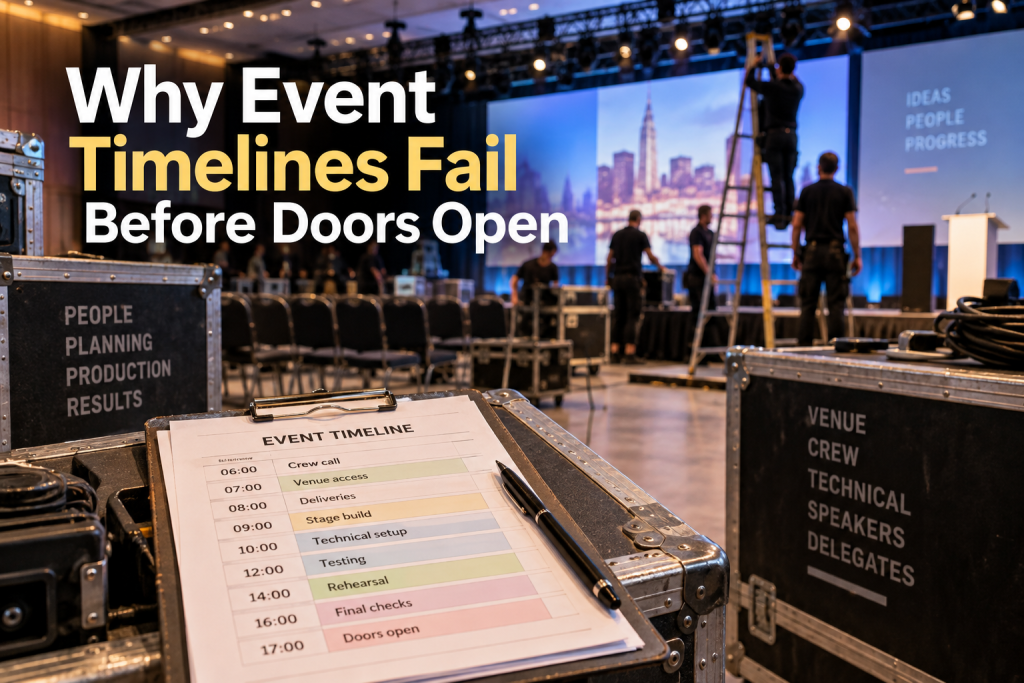
An event timeline can look polished, detailed and reassuring — and still be completely unusable.
After more than 35 years working across Europe on conferences, live events and corporate productions, I learned that the quality of a schedule has very little to do with how neat the spreadsheet looks. What matters is whether the work, people, access, technical requirements and decisions can actually fit into the time available.
The real test of an event timeline is not whether every task has a time beside it.
It is whether the event can survive contact with reality.
The schedule does not go back far enough
Working backwards from doors open is one of the most useful ways to build an event schedule.
The mistake is stopping too soon.
A weak timeline may include rehearsal, technical setup and registration, but ignore everything required before those activities can begin.
Crew call times, loading access, deliveries, room availability, staging, rigging, power, equipment setup, testing, speaker briefing, registration checks and contingency time all need to appear somewhere in the plan.
If the schedule says:
08:00 – Technical setup
that tells me almost nothing.
When can the crew enter the building?
Is the loading bay available?
Can equipment go straight into the room?
Is the stage already built?
Is power available?
Are other contractors still working in the space?
When does the venue actually release the room?
A three-hour setup window can quickly become a ninety-minute setup window once the real access conditions are understood.
The timetable is not ambitious when these details are missing.
It is incomplete.
Dependencies matter more than individual tasks
An event is not a list of independent jobs.
It is a chain of dependent activities.
Lighting cannot be focused until the rig is safe and available.
Audio cannot be properly tested until power, patching, loudspeaker positions and system configuration are complete.
Presentations cannot be checked until the playback system is ready.
Speakers cannot rehearse properly until the microphones, screens and presentation system are working.
Delegates cannot enter smoothly if registration equipment, signage and front-of-house positions are still being prepared.
A schedule containing only start and finish times can hide these relationships.
For every major task, ask:
What has to be complete before this can begin?
That one question exposes many unrealistic timelines.
Technical production usually reveals the problem first
Technical production often exposes weak planning before any other department because technical work depends on physical conditions rather than assumptions.
Equipment needs access.
It needs unloading routes.
It needs power.
It needs positions.
It needs cable routes.
It needs signal paths.
It needs configuration.
And then it needs time for testing.
A conference may also require presentation playback, confidence monitors, remote contributors, interpretation, recording, streaming, clicker testing, speaker microphones and operator handovers.
Those activities cannot sensibly be compressed into one line labelled:
Technical setup
One of the easiest planning mistakes is to allocate a technical team three hours without asking how much of that three hours is genuinely usable.
If the loading bay is shared, catering is moving through the room, staging is incomplete or the venue will not release the space until later than expected, much of that theoretical setup period may disappear before the technical work has properly started.
A realistic schedule should reflect access to the working environment, not simply the time printed in the programme.
Rehearsal is not the same as technical testing
This distinction causes problems surprisingly often.
A rehearsal should not be the first time anyone discovers that a presentation will not display correctly, a video has the wrong format or a microphone does not work as expected.
Technical testing should happen first.
Then rehearsal.
Then final preparation for doors open.
When these activities are treated as one block, the schedule may look efficient but there is no recovery time if anything goes wrong.
If the first speaker arrives for rehearsal while the production team is still troubleshooting the system, the event has already started consuming time it does not have.
Ownership must be clear
Phrases such as:
“Production to confirm.”
“Venue to organise.”
“Team to check.”
are not assignments.
Every critical action needs a clear owner.
That does not mean one person performs every task. It means one person is responsible for making sure the task is complete.
For each important milestone, the schedule should identify:
- the task
- the owner
- the start time
- the finish time
- any dependency
- the current status
- any decision required
If several departments are involved, the timetable should still show who has responsibility for the final decision.
That becomes particularly important when a delay affects another team.
Decision time is part of the timeline
One of the most underestimated causes of delay is approval.
A physical task may take ten minutes.
Getting permission to begin it may take an hour.
A revised running order, artwork approval, room change, access decision or technical substitution may require agreement from the client, venue, supplier or safety lead.
Scheduling the delivery while ignoring the approval path creates a fictional start time.
The timeline therefore needs to include decision points as well as physical tasks.
Ask:
Who needs to approve this?
Who makes the final decision?
What is the latest time that decision can safely be made?
What happens if approval has not arrived?
If nobody knows the answer, the delay has effectively been built into the event.
Buffers are part of the plan
A buffer is not wasted time.
It is protection against normal uncertainty.
A vehicle arrives late.
A room is released later than expected.
A presentation changes.
A cable has to be replaced.
A speaker runs over.
A delegate movement takes longer than planned.
None of these situations is particularly unusual.
Without contingency time, however, one small delay can move through every dependent task that follows.
A realistic schedule should distinguish between working time and recovery time.
It should also be clear what can consume that buffer.
One of the worst habits is quietly using contingency time to make an earlier milestone appear to be on schedule.
Once the buffer has gone, it has gone.
Communication gaps create false confidence
A shared spreadsheet does not guarantee that everyone shares the same understanding.
Different people may be working from different versions.
Someone may have missed a comment.
A change may have been mentioned in a meeting but never formally recorded.
A department may assume another team has been told.
This becomes particularly dangerous when one change creates several consequences.
Moving a session may affect:
- catering
- transport
- interpretation
- speaker arrival
- room turnover
- technical staffing
- rehearsals
- recording
- front-of-house teams
If the timetable changes but those consequences are not communicated, the schedule no longer describes the event that is actually being delivered.
Use planning meetings to make decisions, not simply report status.
Keep one controlled version of the working schedule.
When something changes, record the change and make the operational impact visible.
Start with the immovable constraints
A strong timeline begins with the things you cannot easily move.
These might include:
- venue access
- delegate arrival
- broadcast times
- speaker commitments
- catering service
- transport
- venue restrictions
- required finish time
Once those constraints are known, work backwards and forwards from them.
For every important milestone, ask:
What must be true before this can happen?
Then ask:
Who is responsible for proving that it is true?
That turns a timetable into an operational plan.
Before issuing the final event timeline
Before the final version is circulated, test it against these questions:
- Does every critical task have an owner?
- Have venue access and loading restrictions been confirmed?
- Are setup, technical testing and rehearsal shown as separate activities?
- Do dependent tasks have enough time between them?
- Are decision and approval deadlines visible?
- Is technical testing complete before speakers require the room?
- Is there genuine contingency time?
- Is everyone working from the same version?
- Who has authority to approve changes onsite?
- What happens if the first major milestone is missed?
This exercise often reveals more than another hour spent formatting the spreadsheet.
A timeline is an operational promise
A useful event timeline tells people more than when something should happen.
It explains the order of work.
It identifies the conditions required for progress.
It shows who is accountable.
And it explains how the event can recover when reality does not follow the plan.
Before a schedule becomes a promise to delegates, review it with the venue, client, production, technical and front-of-house leads.
Ask them to challenge the assumptions rather than simply approve the document.
The strongest schedule is not the busiest one.
It is the one that makes pressure visible early enough to manage.
Free Event Planning Timeline & 12-6-3-1 Checklist
Planning a conference or live event?
Download my Free Event Planning Timeline & 12-6-3-1 Checklist — a practical framework for working backwards from doors open, identifying important planning stages and checking that the critical work has been completed before event day.
Read the ArticleAdvertisement
Affiliate link: Discover The Cumberland Hotel — elegant stays at the heart of London.