Avoiding Common Conference Planning Mistakes Before They Become Expensive
Avoiding Common Conference Planning Mistakes Before They Become Expensive
Conference planning mistakes rarely begin as disasters, but they can become expensive when assumptions, late decisions, and unclear responsibilities are not challenged early enough.
They usually begin as small assumptions.
Someone assumes the venue understands the brief. Someone assumes the menu has been approved. Someone assumes the stage design will fit through the loading doors. Someone assumes the local supplier will “just know” what is required.
Then, slowly, those assumptions turn into delays, extra costs, technical problems, frustrated speakers, unhappy delegates and a planning team that suddenly feels as if it is fighting the event instead of producing it.
After more than 35 years working across European conferences, corporate events, live productions and technical environments, I have seen the same pattern many times. The biggest conference failures are often not caused by one huge mistake. They are caused by several small mistakes that were never challenged early enough.
The good news is that many of them can be avoided.
The bad news is that you have to stop relying on hope.
The Assumption Trap
One of the most dangerous habits in conference planning is assuming that what worked in one city will work exactly the same way somewhere else.
This is especially risky when planning events across Europe.
A hotel in London, Paris, Madrid, Vienna or Prague may carry the same international brand name, but that does not mean the operational reality is the same. The staff structure may be different. The building may be older. The local labour laws may affect working hours. Fire regulations may be stricter. Loading access may be limited. Power availability may not match what your technical team expects.
The name above the door does not guarantee the detail behind the scenes.
This is where many planners fall into trouble. They assume the venue has enough power. They assume a “meeting room” includes everything they need. They assume the ballroom floor plan is accurate. They assume the local team has read every page of the event brief.
Assumptions are comfortable because they save time at the beginning.
But they cost money at the end.
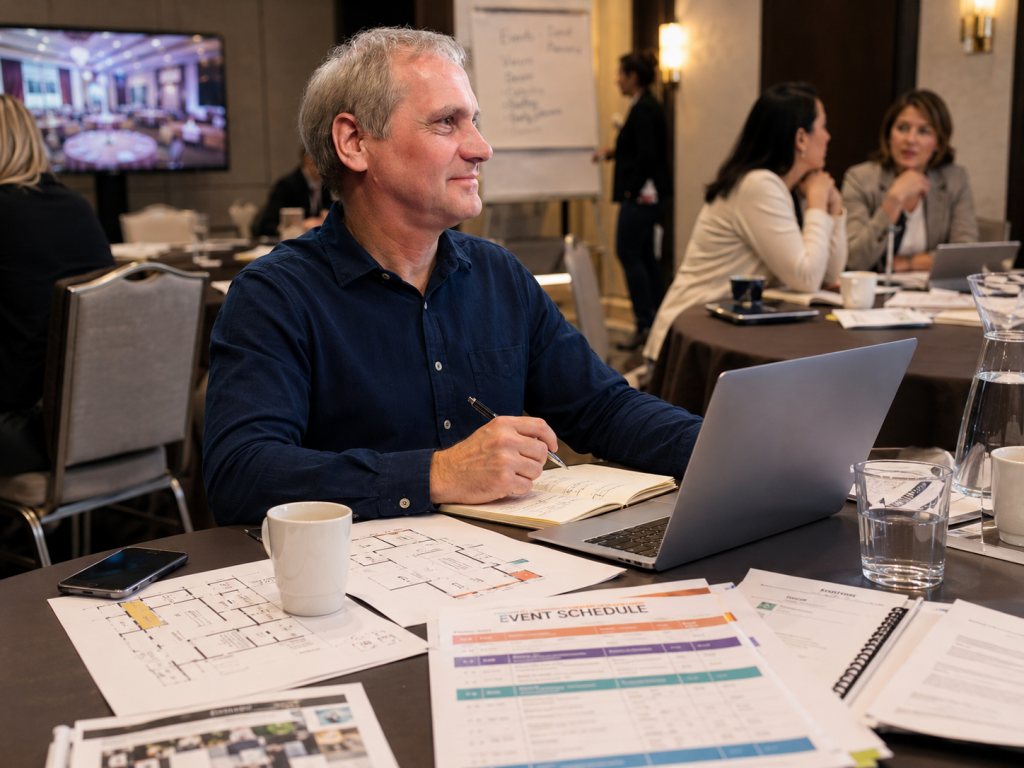
A classic example is the glossy venue floor plan. On paper, the room looks perfect. The dimensions seem right. The seating capacity looks generous. The stage position appears obvious. Then the team arrives on site and discovers that the marketing brochure did not show the four marble pillars blocking the view from half the room.
The pillars were probably there on the technical drawing.
But nobody checked the technical drawing.
That is the difference between planning from a brochure and planning from reality.
Conference Planning Needs Reality Checks
A professional conference plan should never depend only on what looks good in a proposal.
It needs reality checks.
Before committing to a venue, ask practical questions:
Does the room genuinely work for the type of event you are running?
Can every delegate see the stage?
Where are the power points?
Where does the technical equipment come in?
Is there a proper loading bay?
Are there service lifts?
Are there noise restrictions?
Can the ceiling take the weight of the lighting rig?
Where will registration queues form?
Where will delegates go during coffee breaks?
Where will speakers wait before going on stage?
These are not glamorous questions. They are not the sort of questions that appear in the marketing deck. But they are the questions that stop expensive problems later.
A conference is not just a room full of chairs.
It is a moving system of people, equipment, food, timing, signage, transport, speakers, security, translation, lighting, sound, presentation files, Wi-Fi, rehearsals and decisions.
If one part of that system is based on a weak assumption, the whole event can be affected.
The Danger of Silo Planning
The second major conference planning mistake is silo planning.
This happens when different departments work on the same event but do not talk to each other properly.
Marketing wants a dramatic stage design.
Finance wants to reduce the budget.
The technical team knows the venue ceiling cannot support the proposed lighting.
The speaker team is booking presenters with specific requirements.
The travel team is allocating hotel rooms.
The venue is waiting for final numbers.
Everyone is busy. Everyone is working. But nobody is operating from one shared version of the truth.
This is when the gap appears.
The gap is where expensive mistakes live.
The speaker booking team may promise a keynote speaker a suite, while the accommodation team has already allocated all suites to the executive board. The marketing team may approve a set design that looks excellent on screen but cannot fit through the venue doors. The finance team may cut the technical budget before understanding that the “saving” removes the backup system keeping the event safe.
Nobody has to be careless for this to happen.
They only have to work separately.
That is why conference planning needs proper communication structure, not just more meetings.
More meetings do not automatically create clarity. Sometimes they create more confusion, especially when nobody knows who has the final authority to approve decisions.
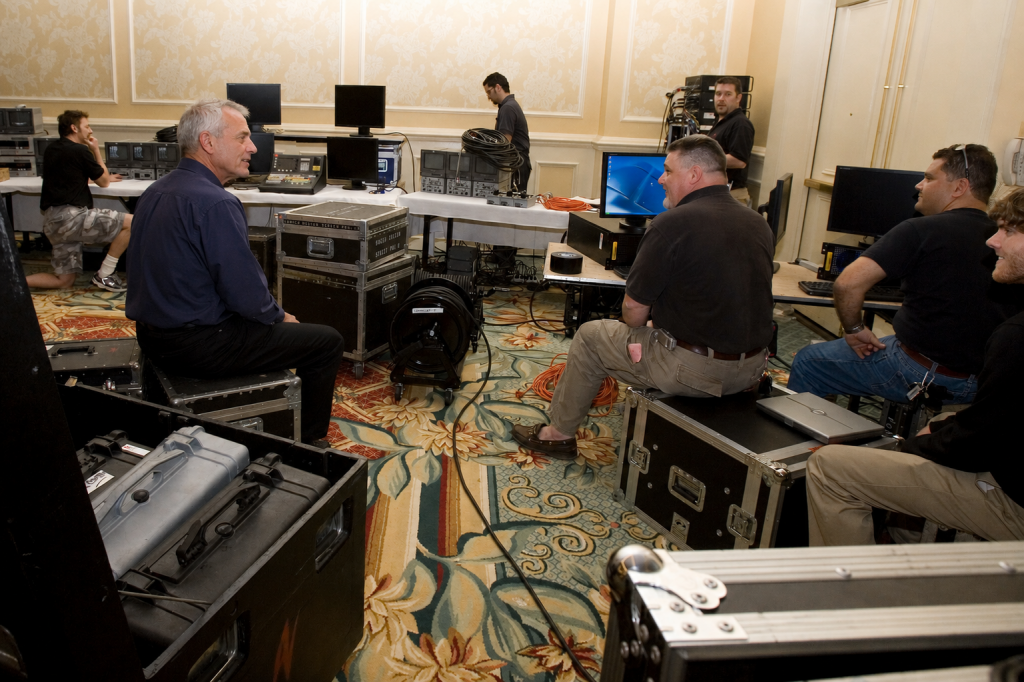
On-site planning in Orlando for Schering-Plough Pharmaceuticals meant turning a hotel room into a working technical hub. With monitors, racks, cables, crews and production cases everywhere, the focus was practical: checking systems, solving problems early, coordinating people, and making sure the conference could run smoothly before delegates arrived.
https://www.omnihotels.com/
This article is adapted from Chapter 4, “Avoiding Common Conference Planning Mistakes” from The European Conference Survival Guide
Design by Committee Slows Everything Down
Many event delays are caused by too many people having a say and too few people taking responsibility.
This is especially common with visible parts of the event: the menu, the stage, the branding, the entertainment, the speaker gifts, the room layout and the creative presentation.
Everyone has an opinion on the “pretty” parts of an event.
Far fewer people want to take responsibility for signing the contract, approving the budget or accepting the operational consequences of a late change.
That creates design by committee.
Design by committee feels democratic, but it is often dangerous. It slows decisions, weakens accountability and pushes pressure onto the event manager or producer, who becomes a messenger between competing opinions.
At some point, a conference needs a decision.
Not another round of comments.
Not another version of the deck.
Not another “quick thought” from someone who has not attended the planning meetings.
A late decision can be worse than an imperfect decision made on time.
Use a RACI Chart Before the Event Gets Political
One practical way to prevent committee chaos is to create a RACI chart.
RACI stands for:
Responsible — the person who does the work.
Accountable — the one person who owns the final yes or no.
Consulted — the people whose advice is needed.
Informed — the people who need to know the decision afterwards.
The most important part is this: there should normally be only one accountable person for each major decision.
If five people are accountable for the menu, the menu will not be approved.
If four people are accountable for the stage design, the design will keep changing.
If nobody is accountable for the budget, every decision becomes a negotiation.
A simple RACI chart can transform the planning process because it makes authority visible. It allows the event lead to say, “This person owns the final decision. These people are consulted. These people are informed.”
That may sound basic, but in real conference planning, it can save weeks.
It also protects the timeline.
Once a sign-off date has passed, the RACI structure gives the event lead a professional reason to push back against late changes. This is not about being difficult. It is about protecting the event.
Free Conference Planning Tool
If your event team is struggling with late approvals, unclear ownership or too many people changing decisions, download my free Conference Decision-Making RACI Chart.
It gives you a simple structure for deciding who is responsible, who has final approval, who should be consulted and who only needs to be informed.
Download the free RACI Chart before your next planning meeting and use it to stop decision delays before they become expensive.
Late Sign-Off Creates a Ripple Effect
Late sign-off is one of the most underestimated causes of conference budget problems.
A two-day delay early in the project can become a major cost later.
For example, imagine the AV supplier is waiting for approval. The delay seems small. But while your team is deciding, the supplier’s preferred rigging crew becomes unavailable. Now they need to bring in another team from another city. That increases cost.
The higher cost requires finance approval.
Finance takes three more days to respond.
Meanwhile, the venue releases the storage space you were planning to use.
Now equipment has to be stored off-site or held in a truck.
The original delay was two days.
The final result is extra labour, extra transport, extra storage and extra stress.
This is why experienced event operators are time obsessed. They understand that time is not just a schedule issue. It is a budget issue.
Every missed decision increases risk.
Every late approval reduces choice.
Every delay pushes the team closer to expensive compromise.
Local Knowledge Is Not Optional
Another common mistake is treating local suppliers as order takers.
This is especially risky when working in European cities where local rules, customs, traffic patterns, venue restrictions and labour expectations can vary dramatically.
A local supplier in Barcelona may know that a football match will create traffic problems near your venue. A production contact in Berlin may know how strict the fire inspection will be. A venue manager in Paris may know that deliveries need to arrive before a specific time because of street access rules. A local technician in Vienna may know that the room looks beautiful but has difficult acoustics.
These people are not just there to carry out instructions.
They are there to help you avoid mistakes you do not yet know you are making.
The better question is not, “Can you do this?”
The better question is, “What would you recommend?”
Instead of saying, “The buses must leave at 8:00,” ask, “If delegates need to be seated by 9:00, what time should the buses leave, given local traffic?”
Instead of saying, “We do not need translation support,” ask, “How many venue staff can confidently handle a technical emergency in English?”
Instead of saying, “Put the stage here,” ask, “Is there anything about this room that would make this stage position difficult?”
Local knowledge is one of the cheapest forms of risk management available. Ignoring it is expensive.
Run a Pre-Mortem Before the Event
One of the most useful planning exercises is a pre-mortem.
A post-mortem asks, “What went wrong?” after the event is over.
A pre-mortem asks the same question before the event happens.
Imagine it is the day after your conference and the event has failed. The delegates were unhappy. The client was angry. The budget was damaged. The team was exhausted.
Now ask: why?
Did the Wi-Fi fail?
Did the keynote speaker arrive late?
Did the registration queue block the hotel lobby?
Did the food run out?
Was the room too hot?
Were the presentations in the wrong format?
Did the translation system fail?
Did the executive rehearsal get cancelled?
Write down the three most likely reasons your event could fail.
Then look at your current plan and ask whether you are actively preventing those problems.
If Wi-Fi failure is a risk, have you arranged a dedicated connection or backup?
If food service is a risk, have you checked the timing, numbers and service style?
If speaker arrival is a risk, who owns travel tracking and on-site greeting?
If presentation failure is a risk, when are files being collected and tested?
The pre-mortem removes false confidence. It forces the team to face the weak parts of the plan while there is still time to fix them.
That is the point.
A professional planner is not someone who believes everything will go well.
A professional planner is someone who asks what could go wrong early enough to do something about it.
Your Immediate Action Step
Take 30 minutes and review the next three major decisions on your event.
For each one, write down:
Who is responsible for the work?
Who is accountable for the final yes or no?
Who needs to be consulted?
Who simply needs to be informed?
Then put a sign-off date next to each decision.
This simple exercise can prevent weeks of confusion. It gives your team a structure. It protects your budget. It stops late changes from becoming operational problems.
Most conference planning mistakes are not mysterious.
They come from assumptions, unclear ownership, poor communication, late sign-off and ignored local knowledge.
Fix those five areas and you will already be ahead of many event teams.
A conference is always under pressure from the clock. The closer you get to opening day, the fewer options you have. That is why the best time to prevent a disaster is not during the final rehearsal.
It is now.
Before the contracts are signed.
Before the stage is built.
Before the delegates arrive.
Before the clock takes control of the event.
Free Download: Conference Decision-Making RACI Chart
Avoid late sign-offs, unclear responsibilities, committee delays and expensive last-minute changes.
This simple RACI chart helps you identify who is responsible, who has final approval, who should be consulted, and who only needs to be informed before key conference decisions are made.
Use it to bring structure to your planning team before confusion turns into cost.
Inside the free RACI Chart, you’ll be able to map:
- Who owns the final decision
- Who is doing the work
- Who needs to be consulted
- Who should only be kept informed
- Which decisions are still waiting for approval
- Where late sign-off could damage your event timeline
Download the free Conference Decision-Making RACI Chart and use it before your next major planning meeting.
Planning a conference in Europe? The European Conference Survival Guide explains how to avoid the hidden costs, venue traps, technical problems and planning mistakes that damage international events. Read the full guide before you sign the next venue contract.
This article is part of my wider collection of
European conference articles.
You may also find it useful to read about
common conference planning mistakes
or explore
The European Conference Survival Guide.