
European conference planning book. The European Conference Survival Guide is a practical field manual for organisers, planners, production teams, and marketing professionals delivering events across Europe.
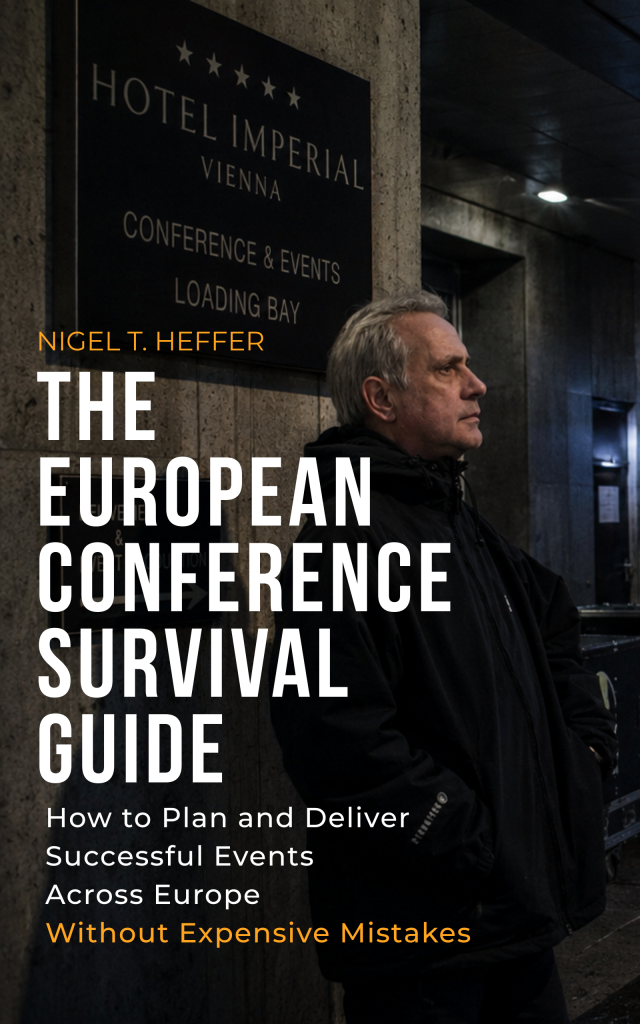
Planning a conference in Europe is far more complex than booking a venue and sending invitations.
Small operational mistakes can quickly become expensive disasters — weak timelines, AV failures, supplier miscommunication, registration bottlenecks, unrealistic budgets, poor logistics, and last-minute technical problems.
The European Conference Survival Guide is a practical field manual for conference organisers, event planners, production teams, and marketing professionals responsible for delivering successful events across Europe.
Drawing on more than thirty-five years of real-world experience in conference production, AV, staging, logistics, and international event operations, Nigel T. Heffer provides a clear and experience-based guide to the realities of planning and managing conferences in complex live environments.
Prefer to Listen? Get the Complete Audiobook Package

7 hours 30 minutes of practical, real-world guidance for delivering conferences across Europe.
Written by: Nigel T. Heffer
Narrated by: Rudy Simmons
Length: 7 hours 30 minutes
Content: 30 chapters
Take The European Conference Survival Guide with you wherever you work. This complete audiobook package gives you the guidance from the 30-chapter professional field manual in audio format, together with practical reference material you can use before site visits, supplier meetings and live events.
Your Complete Audiobook Package Includes
-
Complete M4B Audiobook
The full 7-hour 30-minute audiobook in one convenient file, with chapter navigation for compatible audiobook players. -
Individual MP3 Chapters
Listen chapter by chapter on virtually any phone, tablet, computer or audio player. -
Glossary PDF
A quick-reference guide to the terminology used across European conference planning, technical production and event operations. -
Appendix: The Survival Checklists PDF
Practical, ready-to-use checklists for site visits, supplier meetings, technical planning, production preparation and live event delivery.
Listen to a Free Audiobook Preview
Hear a sample from The European Conference Survival Guide, narrated by Rudy Simmons.
Audiobook Preview — press play to listen.
7 Hours 30 Minutes | 30 Chapters | M4B + MP3 | Glossary PDF | Survival Checklists PDF
Complete Audiobook Package — $22.99
Don’t leave your next European conference to guesswork. Get instant access to the complete audiobook package and practical resources designed to help you plan more effectively, reduce risk and avoid costly surprises.
Plan with confidence. Avoid expensive surprises. Deliver like a professional.
Inside this book, you will learn how to:
Build realistic conference budgets and planning timelines
Avoid common venue selection and event planning mistakes
Manage AV, staging, streaming, and hybrid production
Coordinate suppliers, logistics, hotels, and delegate flow
Understand the operational realities of different European regions
Improve contingency planning and reduce live-event risk
Handle conference problems professionally when things go wrong.
This book covers every stage of conference delivery, including:
• Venue selection
• Technical production and AV
• Delegate management
• Hotels and accommodation
• International logistics and freight
• Streaming and hybrid events
• Risk management and contingency planning
• Contracts, suppliers, and operational coordination
• European conference destinations and regional considerations
From executive retreats in the Swiss Alps to international congresses for thousands of delegates in Berlin, Madrid, Vienna, Amsterdam, and Paris, this guide is built on real operational experience — not theory.
Whether you are planning your first conference or managing large-scale international events, The European Conference Survival Guide will help you avoid expensive mistakes and deliver professional events with greater confidence, control, and operational clarity.
This European conference planning book is especially useful for organisers who need to think beyond the visible parts of an event. It looks at the decisions, assumptions, technical details, supplier conversations, and venue realities that often decide whether a conference runs smoothly or becomes difficult on site.
- Table of Contents
- Introduction — Why Conferences Go Wrong and Why Experience Matters
- Chapter 1 — Defining the Purpose of the Conference
- Chapter 2 — Understanding Different Types of Conferences and Events
- Chapter 3 — Building a Realistic Conference Budget
- Chapter 4 — Avoiding Common Conference Planning Mistakes
- Chapter 5 — Building a Practical Event Planning Timeline
- Chapter 6 — Creating Effective Conference Teams and Responsibilities
- Chapter 7 — How to Choose the Right European Conference Destination
- Chapter 8 — Understanding European Conference Seasons and Pricing
- Chapter 9 — Barcelona, Madrid and Southern European Destinations
- Chapter 10 — Vienna, Prague and Central European Conference Cities
- Chapter 11 — Amsterdam, Copenhagen and Northern European Destinations
- Chapter 12 — Paris, Berlin and Major International Conference Hubs
- Chapter 13 — Venue Selection Mistakes and Hidden Operational Problems
- Chapter 14 — Why Conference AV Goes Wrong
- Chapter 15 — Sound, Lighting and Presentation Management
- Chapter 16 — Stage Management and Backstage Coordination
- Chapter 17 — Streaming, Recording and Hybrid Event Production
- Chapter 18 — Internet Connectivity, Wi-Fi and Technical Infrastructure
- Chapter 19 — Working Effectively with AV and Production Suppliers
- Chapter 20 — Registration Systems and Delegate Communication
- Chapter 21 — Managing Delegate Flow, Signage and Crowd Movement
- Chapter 22 — Hotels, Accommodation and Room Block Management
- Chapter 23 — Transport, Freight and International Logistics
- Chapter 24 — Catering, Hospitality and Cultural Expectations
- Chapter 25 — Choosing and Managing Event Suppliers
- Chapter 26 — Contracts, Insurance and Legal Considerations
- Chapter 27 — Risk Management and Contingency Planning
- Chapter 28 — What To Do When Things Go Wrong During Live Events
- Chapter 29 — Measuring Success and Evaluating Conference Performance
- Chapter 30 — Building Long-Term Conference Quality and Professional Standards
- Conclusion — Conferences Succeed Through Preparation, Not Luck
- Glossary
- Reading List
- About the Author
- Appendix: The Survival Checklists
This book connects with my wider collection of European conference articles, including practical guidance on building a realistic conference budget and avoiding common conference planning mistakes.