
Article 1.
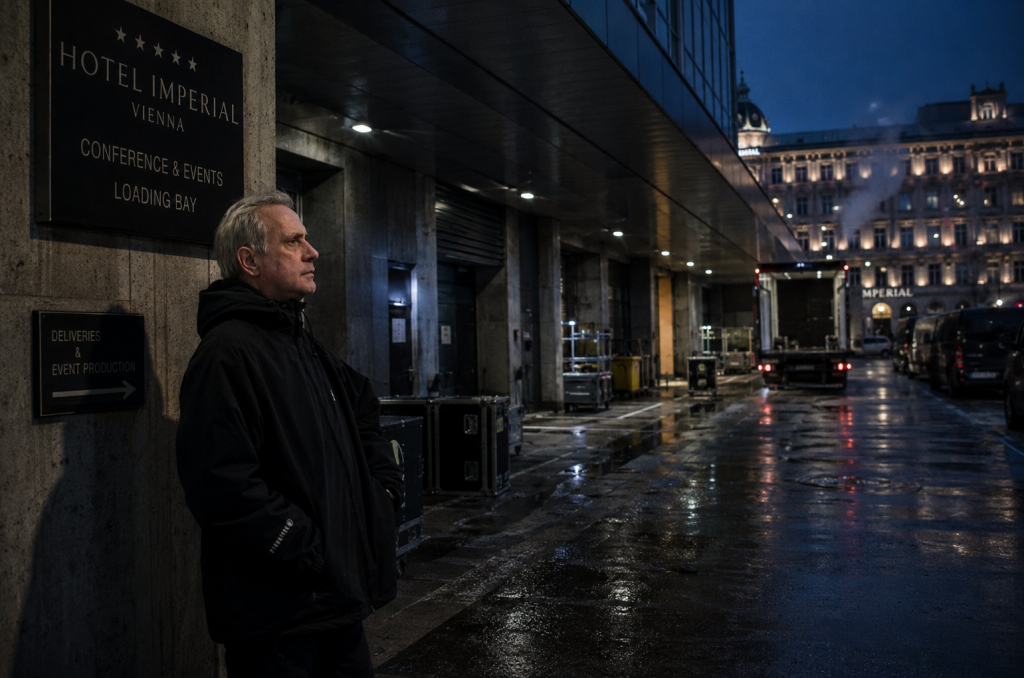
In the early hours of a freezing winter morning in Vienna, I stood alone in a loading bay beneath a five-star conference hotel, waiting for a truck that should have arrived three hours earlier.
Upstairs, hundreds of delegates from across Europe would begin arriving in less than six hours. The stage still wasn’t built. Half the AV equipment was somewhere between Germany and Austria, delayed at a border crossing that nobody had warned us about.
The client didn’t know.
The speakers didn’t know.
But I knew that if we didn’t solve the problem quickly, an international conference with senior executives, live presentations, interpreters, and satellite-linked sessions could start to collapse before the doors even opened.
That moment taught me something I would see repeatedly over more than 35 years of working across European conferences, live events, and corporate productions:
- The audience only sees the final event.
- They never see the chaos concealed behind the curtain.
Most people think conferences are about schedules, hotels, and presentation slides. In reality, international events are operational pressure systems that involve logistics, technology, human behaviour, cultural differences, budgets, risk management, and hundreds of moving parts that must work together perfectly under time pressure.
And when you move those events across Europe, everything becomes more complicated.
Different countries.
Different labour rules.
Different technical standards.
Different venue expectations.
Different ways of working.
I’ve seen events nearly fail because of power limitations in historic buildings in Prague, transport strikes in France, missing freight in Spain, incompatible electrical systems in older venues, and technical suppliers who promised far more than they could deliver.
Over the decades, I worked as a technical manager, sound engineer, production manager, and conference operations specialist across European cities, venues, hotels, and at international corporate events. I quickly learned that successful conferences are never built on luck.
They are built on preparation, systems, experience, and an understanding of how European venues and production environments really work behind the scenes.
The Audience Never Sees the Real Work
When delegates arrive at a conference, they see polished registration desks, carefully lit stages, fresh coffee, branded signage, and presenters confidently taking the stage. What they don’t see is what happened twelve hours before.
They don’t see exhausted crews unloading flight cases at 2:00 AM in the rain behind a hotel in Amsterdam. They don’t see technicians tracing faulty signal paths through temporary cabling in Berlin. They don’t see production teams working to resolve power-distribution problems in centuries-old buildings in Prague, where modern technical requirements clash with historic infrastructure.
They certainly don’t see the quiet panic backstage when a presentation laptop fails to connect seconds before a keynote begins.
The truth is that conferences operate like live theatre. If the audience notices the operational work, something has already gone wrong.
The real skill in conference production is making the complex look effortless. That becomes far harder when you are working internationally.
In your home city, you know the suppliers. You understand the venue’s limitations. You know who to call when something breaks. You understand the local working culture and how quickly problems can realistically be resolved. But the moment you start running events across Europe, many of those safety nets disappear. Suddenly, small mistakes become costly.
This lesson is explored in greater detail in my book, The European Conference Survival Guide: How to Plan and Deliver Successful Events Across Europe Without Expensive Mistakes. Read more…
Why European Conferences Are Different
On paper, Europe can seem deceptively simple. Countries are geographically close, flights are relatively short, and major cities are well connected. However, operationally, Europe is a patchwork of systems, expectations, regulations, and working cultures.
One city may allow overnight access to venues, while another enforces strict labour shutdown periods. One venue may include basic technical infrastructure, whereas another charges separately for each power connection, cable run, and rigging point.
I’ve worked in venues where loading access was restricted to narrow delivery windows because city-centre traffic regulations prohibited truck movements during business hours. I’ve also seen organisers realise far too late that a “conference venue” was originally designed for banquets rather than modern hybrid presentations that require substantial power and network capacity.
These are the kinds of details glossy brochures rarely mention. Then there are the hidden financial realities.
Many first-time organisers underestimate the impact of VAT, local supplier mark-ups, union regulations, overtime structures, and last-minute logistics costs. A technical setup that seems straightforward in London can suddenly double in cost elsewhere once local rules and venue policies are applied.
Cultural expectations also matter far more than many planners realise. Business hospitality in parts of Europe still centres on relationship-building and extended dining experiences. Forcing fast-moving schedules into environments where delegates expect time to talk, network, and socialise can completely alter the atmosphere of an event.
These things matter because conferences are not simply about presentations. They are about people. And people respond differently depending on the environment, culture, comfort, timing, and organisation.
The Experience Gap Most Planners Discover Too Late
Over the years, I began to think of this as “the Experience Gap.” The Experience Gap is the distance between the event plan on your laptop and the reality of the venue floor. On paper, everything always looks manageable. Schedules align neatly. Budgets appear realistic. Suppliers promise smooth delivery. Timelines feel achievable.
Then reality arrives.
A freight shipment is delayed. A venue’s power supply cannot support the production requirements. Local crews work to schedules different from those expected. Internet bandwidth proves insufficient for live streaming. Equipment arrives damaged. Translation booths fail testing an hour before delegates arrive.
This is where experience matters most.
Not because experienced professionals prevent every problem, but because they recognise risks early enough to minimise the damage. One of the biggest mistakes inexperienced organisers make is assuming the venue will “handle everything.” In reality, venues are businesses with operational limitations, staffing structures, contractual restrictions, and their own financial priorities.
A beautiful ballroom tells you nothing about:
- loading access
- backstage workflow
- rigging capability
- acoustic quality
- internet reliability
- power distribution
- crew access
- storage space
- equipment routes
These are the details that determine whether an event feels seamless or stressful. After enough years in conference production, you start noticing problems before they happen. You walk into a room and immediately look for power access, ceiling height, cable routes, projection sightlines, and bottlenecks in delegate movement. You stop seeing venues as “beautiful spaces” and start seeing them as operational systems.
That shift changes everything.
What 35 Years in European Events Taught Me
The longer I worked in conferences and live events, the more I realised that technical knowledge alone is never enough. The best event professionals combine logistics, communication, psychology, leadership, and calm decision-making under pressure.
You learn to negotiate with stressed venue managers at midnight. You learn to reassure clients while resolving technical failures backstage. You learn to make swift operational decisions with incomplete information, keeping teams focused and moving forward. Most importantly, you learn that preparation breeds confidence. The events that succeed are rarely the ones with the biggest budgets.
They are usually the events with:
- realistic planning
- experienced crews
- clear communication
- proper contingency systems
- strong operational leadership
That is true whether you are running a leadership summit in Vienna, a pharmaceutical conference in Barcelona, or a corporate roadshow spanning multiple European cities. The public sees the finished presentation. But behind every successful conference lies an invisible operational structure built by people solving problems long before delegates enter the room.
That hidden world fascinated me for decades, and it’s also why I began writing about it.
After spending more than 35 years travelling across Europe, working in conference venues, hotels, exhibition halls, and production environments, I realised that very few people ever explain what actually happens behind the scenes. Not the glossy marketing version. The real version.
The version involving loading docks, overnight setups, technical failures, exhausted crews, impossible deadlines, and the strange satisfaction of watching everything finally work exactly as planned when the doors open and the audience walks in, completely unaware of how close the entire production once came to disaster.
What I Learned From Watching Event Planners Under Pressure
One of the unexpected advantages of working as a technician, sound engineer, and technical manager across European conferences was that I often saw a side of corporate events most delegates never witness.
During the day, I watched company event planners and production managers standing confidently at the front of major conferences, leading meetings, coordinating speakers, and managing demanding schedules in front of senior executives and international clients.
But later in the evening, after the sessions finished and the delegates disappeared into hotel bars or restaurants, the crew would often share a meal and a couple of drinks with the organisers behind the scenes.
That was where the real conversations began.
Because I was part of the technical crew rather than corporate management, people spoke openly. They talked about what was going wrong, which suppliers were causing problems, which executives were creating pressure behind the scenes, and why certain events felt like disasters despite looking successful to the audience.
Some organisers were completely in control.
Others clearly were not.
I became fascinated by the difference.
The best event leaders were rarely the loudest people in the room. They stayed calm under pressure, trusted their crews, communicated clearly, and focused on solving problems before they became visible to delegates.
The weaker organisers often did the opposite. They reacted emotionally, ignored operational warnings, changed plans at the last minute, or became overwhelmed by details they didn’t fully understand.
Watching those differences over many years taught me lessons no training course ever could.
I learned that successful conferences are not built on appearances. They are built on preparation, operational awareness, communication, and trust between teams working behind the scenes.
I carried those lessons forward when I eventually managed my own productions and events across Europe, and that knowledge proved invaluable.
It taught me how to spot problems early.
How to lead calmly under pressure.
How to communicate with technical crews.
And how to understand the difference between an event that merely looks successful and one that is genuinely under control operationally.
That experience is one of the reasons this website now exists.
After more than 35 years working across European venues, conferences, corporate productions, and live events, I wanted to share the practical realities most people never talk about publicly — the operational lessons, backstage experiences, technical challenges, travel realities, and leadership insights that only emerge when you spend decades working behind the curtain of international events.
Avoid Expensive Conference Mistakes
This article is based on lessons from my book:
The European Conference Survival Guide: How to Plan and Deliver Successful Events Across Europe Without Expensive Mistakes
Drawing on more than 35 years working across conferences, exhibitions and corporate events throughout Europe, the book provides practical guidance for organisers, planners and event professionals.
Inside you’ll learn:
✓ Venue selection strategies
✓ Conference budgeting
✓ Technical planning
✓ European compliance issues
✓ Supplier management
✓ How to avoid costly event failures